Quick answer
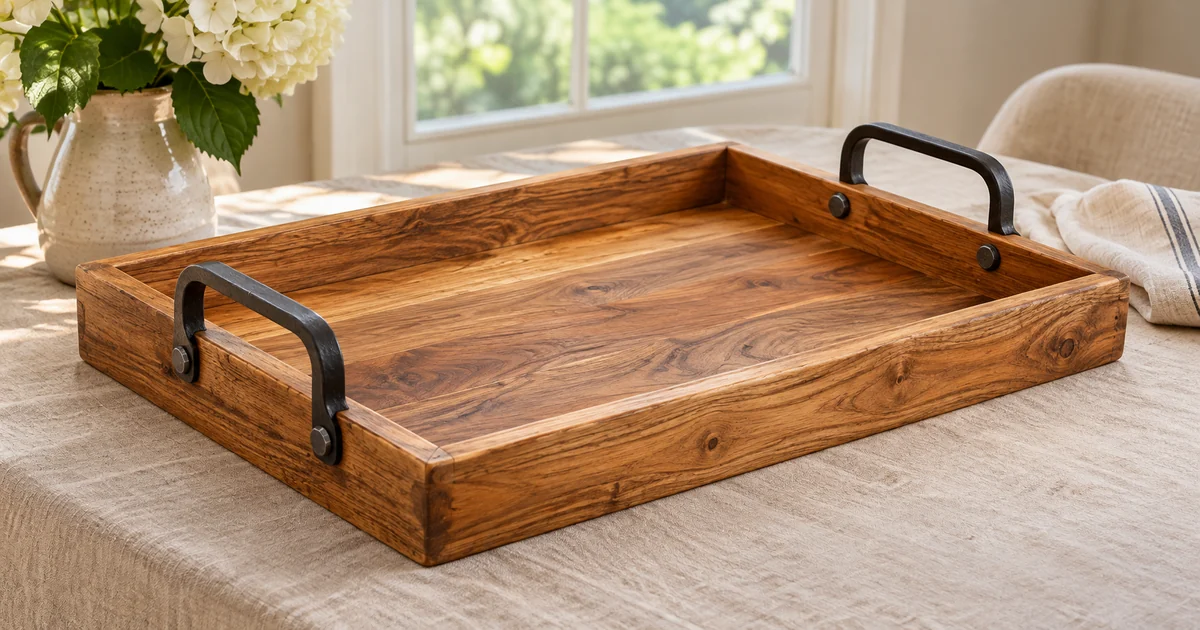
A wood and iron serving tray pairs a wooden base with black iron or steel handles, usually for a farmhouse or industrial look. The details that matter are how the handles attach (bolts or screws through the wall are sturdier than short screws into it), how much the tray weighs when loaded, whether the underside has feet or pads, and whether the wood finish is meant for food. The same checks apply to any wood tray with black handles.
How the handles attach
| Attachment | How it looks | Strength and checks |
|---|---|---|
| Bolts through the wall with nuts or caps | Hardware visible inside and outside | Generally the most secure; check nuts stay tight |
| Screws through the wall into the handle | Screw heads inside the tray | Good if screws are long enough; may loosen as wood moves |
| Screws into the outside of the wall | No hardware inside | Clean look; depends on screw length and wall thickness |
| Rivets | Domed heads | Secure but hard to tighten later |
| Handles set into the base underneath | Hidden fixings | Check by lifting a loaded tray gently |
Wood and iron serving tray: what to check before buying
Seven checks
- Handle fixing type and whether hardware shows inside the tray.
- Handle clearance: room for fingers between handle and wall.
- Weight: iron handles add weight; large solid trays get heavy loaded.
- Underside: feet, pads or a flat base; iron hardware can scratch tables.
- Wood and finish: species, stain or whitewash, and stated food use.
- Rust: iron can rust if left wet; look for a powder-coated or sealed finish in the details.
- Inner base after the walls.
Wood tray with black handles: style notes
Black handles suit farmhouse, industrial and modern rustic rooms, and pair well with whitewashed, natural acacia and dark walnut wood. Whitewashed trays with black handles are a common combination in current listings, often with matching coasters. If you mix metals in a room, black handles go with almost anything; gold and brass handles read more formal. For heavier daily use, choose solid wood bases with through-bolted handles.
Weight and carrying
Metal handles make a tray easier to grip than shallow cut-outs, but the added weight adds up. A large tray with solid wood, iron handles and a full load of drinks can be awkward for one hand. Carry loaded trays with both hands, close to your body, and choose a smaller tray for stairs. Listings sometimes state the empty weight; when they do, compare it.
Researched selection: wood and iron trays
Our recommended products are near the top of this guide. These Amazon searches help you compare more options.
Browse on Amazon
- Acacia trays with black iron handlesCheck how handles are fixed.
These are Amazon search links, not endorsements of every result. Use the checks on this page to filter them.
Care
- Wipe the wood with a damp cloth and dry immediately.
- Dry the iron handles too; moisture can rust bare iron.
- Never soak or put in the dishwasher.
- Snug handle screws or nuts when they loosen.
- Use felt pads under the tray if hardware touches the table.
Before you buy: what to confirm in the listing
For a wood and iron tray, look closely at how the handles attach: bolts or long screws through the wall are the most secure. Check whether hardware shows inside the tray, the handle clearance for your fingers, and the overall weight. Read the wood description and finish, especially for whitewashed or stained trays, and whether food use is stated.
Check whether the handles are coated or bare iron, since bare iron can rust if left damp. Finally, look for felt pads or feet, which keep metal hardware off your table.
Our take
Wood and iron trays are a strong choice when you carry trays often and like a farmhouse or industrial look. Choose through-bolted handles, dry them after cleaning, and treat painted or whitewashed bases as decor unless the seller states food use. They are easy to live with once you know those few habits.
What affects the price
Wood and iron trays cost more with solid wood bases, larger sizes and heavier handles. Whitewashed or stained decor trays with light handles are often inexpensive, while solid hardwood trays with through-bolted handles cost more. Sets with coasters can add value. For trays you will carry often, spend on the handle fixing and the base thickness rather than on decorative finishes.
Who should choose wood and iron
Wood and iron trays suit people who carry trays often and want a firm grip: metal handles give more finger room than most cut-outs, and the hardware is easy to inspect and tighten. They also suit farmhouse and industrial rooms, where black metal echoes light fixtures, cabinet pulls and furniture legs.
They suit people less well if weight is a concern, since metal handles and solid wood add up, or if the tray will sit in damp places, since bare iron can rust. In a bathroom or near a sink, a tray with coated handles or a different handle material will need less upkeep.
If you like the look but not the weight, consider a smaller tray with iron handles for drinks and a lighter bamboo or cut-out-handle tray for larger loads. Mixing two trays of different sizes but similar color often looks better than one large tray anyway.
Matching handles and other metal in a room
Black iron handles go with almost any metal in a room, which is one reason they are so popular. They echo black light fixtures, cabinet pulls and furniture legs, and they also sit comfortably next to brass and chrome without clashing. Gold and brass handles feel warmer and more formal, while chrome reads modern.
When styling a wood and iron tray, repeat the black somewhere else in the arrangement: a black candle holder, a black picture frame, the lettering on a bottle. That small repetition makes the tray look intentional rather than an isolated farmhouse piece.
Sizes for wood and iron trays
Wood and iron trays come in sizes from small round trays of about 10 to 12 inches, good for coffee for two, to large rectangles of 20 inches and up for ottomans. For carrying drinks, around 16 to 20 inches is a comfortable size: big enough for four to six glasses, small enough to hold steady. For decor on a coffee table, choose by the table, leaving space around the tray.
Gifts and pairings
A wood and iron tray makes a practical housewarming gift for farmhouse and industrial-style homes. Pair it with coasters, a candle in a black metal holder or a small plant on a saucer, and add a note about drying the handles after cleaning. For a kitchen gift, add a bottle of olive oil and a salt cellar so the tray is ready to use beside the stove.
Rustic versus modern looks
The same wood and iron combination can look rustic or modern depending on the wood finish. Distressed or whitewashed wood with black handles reads farmhouse; smooth dark walnut or black-stained wood with slim black handles reads modern and minimal. Choose the finish to match the room rather than the handles alone.
Checking handles on arrival
- Hold the empty tray by the handles and gently rock it; nothing should move.
- Look inside the tray for screw heads or nuts and check they sit flush.
- Load the tray with a few books and lift it carefully a short way above a soft surface.
- Check again after a week of use; screws often settle and need snugging.
- If a handle loosens repeatedly, the screw may have stripped the wood; a slightly longer or wider screw, or a bolt, may be needed.
Styling a wood and iron tray
- Coffee table: a candle in a glass holder, a small plant on a saucer, a stack of coasters.
- Kitchen counter: oil and vinegar bottles, salt cellar and a pepper mill.
- Bar cart: bottles and glasses, with handles making it easy to move.
- Breakfast tray: plate, mug and juice glass, with a cloth liner if the finish is decorative.
Common mistakes
| Mistake | Result | Fix |
|---|---|---|
| Leaving iron handles wet | Rust spots | Dry after cleaning |
| Overtightening screws | Stripped holes or cracked wood | Snug gently by hand |
| Dragging the tray | Hardware scratches furniture | Lift, and add felt pads |
| Serving food on whitewash without a statement | Unknown finish contact | Use plates or a liner |
Rust: prevention and light removal
Bare or worn iron can show surface rust if it stays damp. Dry handles after cleaning and keep trays out of steamy spots near kettles and dishwashers. Light surface rust on a plain decor tray can often be removed with fine steel wool used carefully on the metal only, then wiped clean; protect the wood around it. A thin coat of paste wax on the metal can help slow rust. On powder-coated handles, avoid abrasives and simply wipe dry.
How we researched this guide
Attachment types are described in general terms from common construction. Listing details come from Amazon titles and search snapshots in November 2026. We have not load-tested or measured any trays.
Decision summary
- Through-bolted handles on a solid wood base for regular carrying.
- Whitewashed or stained trays for decor, with plates for food unless food use is stated.
- Check fixings every few months.
Frequently asked questions
Do iron handles rust?
Bare iron can if left wet. Dry handles after cleaning; coated handles resist rust better.
Can I replace the handles on a wood tray?
Often, if the new handles match the hole spacing or you are comfortable drilling. Check wall thickness first.
Why are my tray handles loose?
Wood moves with humidity, loosening screws. Snug them gently.
Are wood trays with black handles food safe?
It depends on the wood finish and stated use. Many are sold as decor.
Do metal handles scratch tables?
If they touch the surface, they can. Felt pads help.
Are iron handle trays heavy?
Heavier than cut-out handle trays of the same size. Check the listed weight.
What wood looks best with black handles?
Whitewashed, natural acacia and dark walnut are popular combinations.
How do I remove rust from iron handles?
On bare iron, fine steel wool on the metal only, then wipe clean and dry. Protect the wood around it.
Are black handles powder coated?
Some are. Listings do not always say; ask the seller if rust resistance matters.
Can I use a wood and iron tray in a bathroom?
Coated handles cope better with humidity. Wipe the tray dry and keep it away from direct splashes.
Do iron handles make a tray easier to carry?
Usually, yes. They give more finger room than shallow cut-outs and a firmer grip when the tray is loaded.
Are wood and iron trays heavy to ship?
They weigh more than plain wood trays, but most are still easy to ship and carry.
Can I replace a broken iron handle?
Yes, with a handle of the same hole spacing. Hardware stores sell matching pulls.
Are wood and iron trays easy to clean?
Yes: wipe the wood, dry the handles and avoid soaking.
What size handles are most comfortable?
Handles with room for four fingers and a little extra clearance are comfortable for most people. Check the handle opening in photos or ask the seller for the measurement.
What size tray for an ottoman?
Measure the ottoman and leave a few inches visible around the tray.
Do iron handles get hot?
Only if placed near heat. Keep the tray away from stovetops and ovens.
Do wood and iron trays suit modern homes?
Yes, especially with smooth dark wood and slim handles.
Can I put a wood and iron tray on a glass table?
Yes, but add felt pads under the tray and any metal feet so the hardware does not scratch the glass.
Can I paint iron handles?
Yes, with a metal paint after cleaning and light scuffing. Remove the handles first if you can.
Are wood and iron trays good gifts?
Yes, especially for farmhouse and industrial-style homes. Include a note on drying the handles.
Sources and further reading
- USDA FSIS: Cutting boards and food safety (fsis.usda.gov)